This guide contains affiliate links. If you buy through them, Arrive Outdoors may earn a commission at no extra cost to you. Learn more.
A Sawyer Squeeze gravity setup is simple: fill a dirty water bag, screw the Squeeze onto it, connect the filter's outlet to a clean bottle or bag, and hang the dirty bag above the clean container. Gravity pushes water through the filter while you pitch the tent or cook. It's slower per liter than squeezing, but it's hands-free and easy on the filter and bags, which makes it the better choice when you need several liters at camp. Below: the parts, the steps, how to keep flow up, and what a hollow-fiber filter does and doesn't protect you from.
What the Sawyer Squeeze does (and doesn't) remove
The Sawyer Squeeze water filter uses hollow-fiber membranes: bundles of tiny tubes with 0.1-micron pores in their walls. Water passes through the walls; particles larger than the pores stay behind.
| Contaminant | Hollow-fiber filter (0.1 micron) |
|---|---|
| Protozoa (Giardia, Cryptosporidium) | Removed |
| Bacteria (E. coli, Salmonella, etc.) | Removed |
| Sediment and microplastics | Removed (but silt clogs the filter fast) |
| Viruses (norovirus, hepatitis A) | Not removed — viruses are far smaller than the pores |
| Chemicals, pesticides, heavy metals, salt | Not removed |
| Taste and odor | Largely unchanged (no activated carbon) |
In most remote North American backcountry, protozoa and bacteria are the main concerns, which is why hollow-fiber filters are the standard choice. Viruses become more of a concern near heavy human use, below campgrounds and towns, and in international travel. In those cases, add a chemical treatment (chlorine dioxide tablets or drops are effective against viruses) or bring water to a rolling boil, which the CDC recommends for 1 minute, or 3 minutes above 6,500 ft (about 2,000 m). Filters don't help with water near mines, agricultural runoff, or blue-green algae blooms — find another source.
Why use a gravity setup
- Hands-free: it runs while you do other things.
- Easier on gear: squeezing hard is the main way people split the dirty pouches and blow out seals.
- Better for groups: filling 4–6 liters for dinner, breakfast and the next day's bottles is tedious by hand.
- Same filter: you can still squeeze or drink through it inline during the day.
The trade-off is speed. Gravity flow depends on how high the dirty bag hangs and how clean the filter is. If you need a liter right now on the trail, squeeze it.
Parts you need
- Sawyer Squeeze filter (the full-size Squeeze flows noticeably faster than the Mini or Micro).
- A dirty water bag with a standard threaded opening that fits the Squeeze. A bag with a wide opening at the other end makes scooping from shallow streams much easier. The CNOC Vecto 2L water bag is a popular choice for exactly this: slide-seal top for filling, threaded spout for the filter.
- A coupling or short hose. Sawyer sells a coupling that joins the filter outlet to a standard bottle thread, and hose adapters let you run into a hydration bladder.
- A clean container: a soft flask, a bottle with standard threads (thin disposable bottles fit), or a hydration bladder with a quick-connect.
- Cord: 6–10 ft (2–3 m) of light cord to hang the bag from a branch or trekking pole.
- The backflush syringe that comes with the Squeeze (or a coupling setup that lets a clean bottle push water backward).
Step-by-step setup
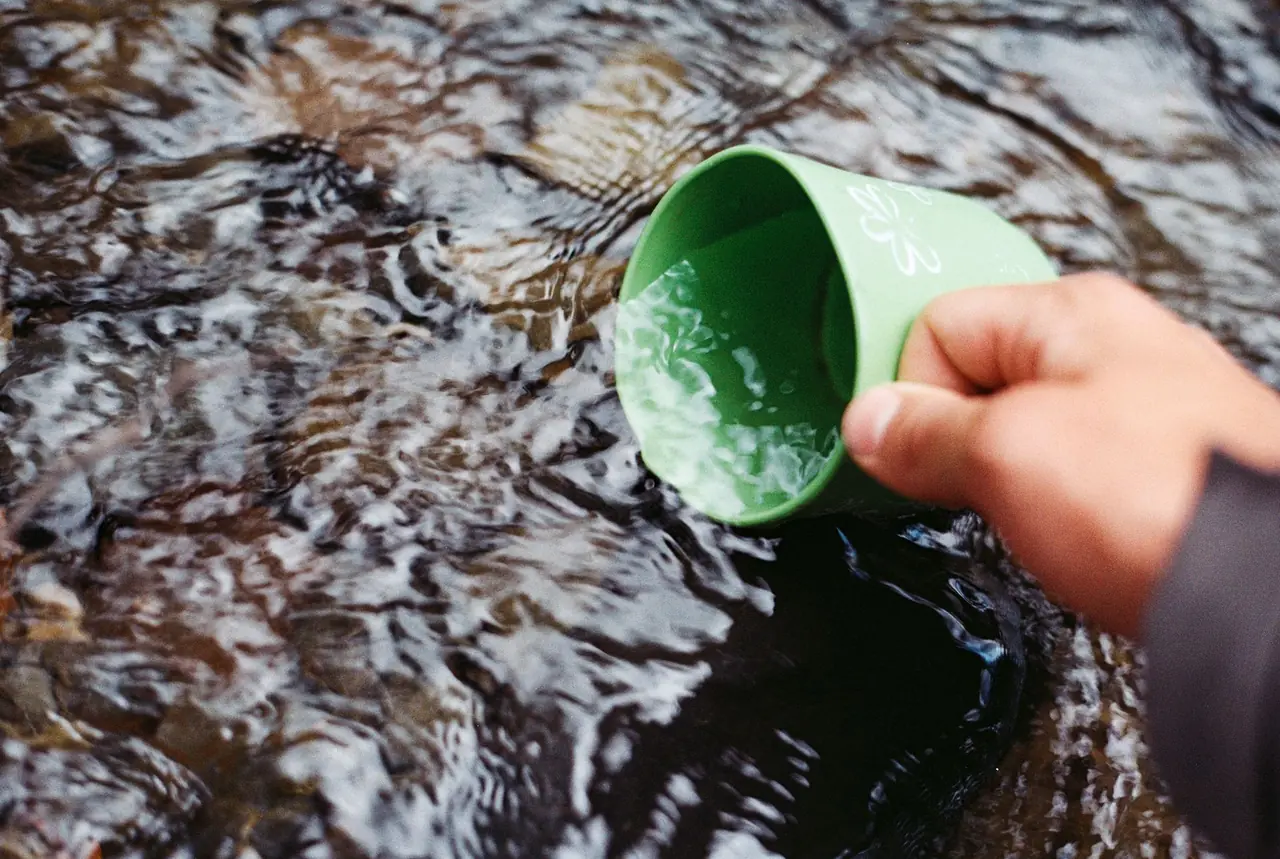
- Fill the dirty bag. Scoop from moving water if possible, away from silt and scum. If the source is murky, pour it through a bandana or let it settle in a pot first.
- Attach the filter. Screw the Squeeze onto the dirty bag's threaded spout, snug but not forced.
- Connect the clean side. Attach the coupling or hose to the filter's outlet and connect the clean bottle, flask or bladder.
- Hang it. Tie the dirty bag (filter pointing down) to a branch, a trekking pole jammed upright, or a rock ledge. The clean container sits on the ground below.
- Open the flow. Pull open the filter's push-pull cap. Water should start dripping and then run in a steady stream.
- Swap containers as they fill. Keep the dirty bag topped up for the next round.
For a quick option without hanging, you can also lay the dirty bag on a rock above a clean bottle on lower ground, or hold it overhead for a minute. Height is what matters.
Getting better flow
- Hang it higher. Every foot of drop adds pressure. A bag hung at head height with the clean container on the ground flows much better than one a foot off the ground.
- Use a longer hose to increase the height difference if there's nowhere high to hang.
- Prime it. If it starts slow, give the dirty bag a gentle squeeze to push air out of the filter.
- Prefilter silty water. Glacial runoff and muddy desert pools clog hollow fibers quickly.
- Backflush as soon as you notice flow dropping, not after it has slowed to a drip.
Backflushing and maintenance
Hollow fibers trap debris on their inside walls. Backflushing pushes clean water backward through the outlet to dislodge it.
- Fill the syringe with clean, filtered water.
- Attach it to the filter's outlet (the clean side).
- Push hard and fast; dirty water comes out the inlet side. Repeat until it runs clear.
Backflush in the field whenever flow slows, and thoroughly at the end of each trip before storing. Let the filter dry with caps off before long storage. Sawyer's own instructions cover cleaning in detail on the manufacturer's site.
Pros and cons
| Pros | Cons |
|---|---|
| Hands-free and easy on bags and seals | Slower per liter than squeezing |
| Light: filter, bag and coupling weigh a few ounces | Needs a place to hang it |
| Filter is field-cleanable | Doesn't remove viruses or chemicals |
| Scales well for groups | Vulnerable to freezing |
Choosing a water filter for backpacking
A squeeze filter isn't the only option. Here's how the common methods compare:
| Method | Protozoa / bacteria | Viruses | Speed | Best for |
|---|---|---|---|---|
| Squeeze / inline hollow fiber | Yes | No | Fast | Solo and pairs, ultralight |
| Gravity hollow fiber (this setup or a dedicated gravity kit) | Yes | No | Hands-free | Groups, camp water |
| Pump filter | Yes | Only purifier models | Moderate | Shallow or difficult sources |
| Chemical (chlorine dioxide) | Yes (Crypto needs the longest contact time) | Yes | Wait 30 min to 4 hrs | Backup, international travel |
| UV pen | Yes | Yes | About a minute per liter | Clear water only; needs batteries |
| Boiling | Yes | Yes | Slow, uses fuel | Cold weather, when a filter may be frozen |
A common, reliable setup for most backpackers is a hollow-fiber filter plus a few chlorine dioxide tablets as backup in case the filter freezes, clogs or breaks. Always follow the specific product's contact times and instructions.
Treated water is also what you should use for brushing teeth and washing dishes; see our backpacking hygiene guide. Heading out in the cold? Our cold weather camping guide covers keeping water liquid and filters from freezing.
Frequently asked questions
How do you set up a Sawyer Squeeze as a gravity filter?
Fill a dirty water bag with a threaded opening, screw the Squeeze onto it, connect the filter outlet to a clean bottle or bag with a coupling or short hose, and hang the dirty bag above the clean container. Gravity pushes water through the filter.
Does the Sawyer Squeeze remove viruses?
No. The Squeeze is a hollow-fiber filter rated to remove bacteria and protozoa such as Giardia and Cryptosporidium. It is not designed to remove viruses or chemicals. Where viruses are a concern, add chemical treatment or boil.
What happens if a Sawyer Squeeze freezes?
Freezing can crack the hollow fibers and there is no reliable way to check a filter in the field. Sawyer advises replacing a filter you suspect has frozen. In cold weather, keep it in an inside pocket by day and in your sleeping bag at night.
How often should you backflush a Sawyer Squeeze?
Whenever flow noticeably slows, and at the end of every trip. Use the included syringe or a coupling with clean water to push water backward through the outlet.
Is a gravity setup slower than squeezing?
Usually yes, per liter. The benefit is that it runs hands-free while you do other camp chores, which makes it easier to filter several liters for a group.